
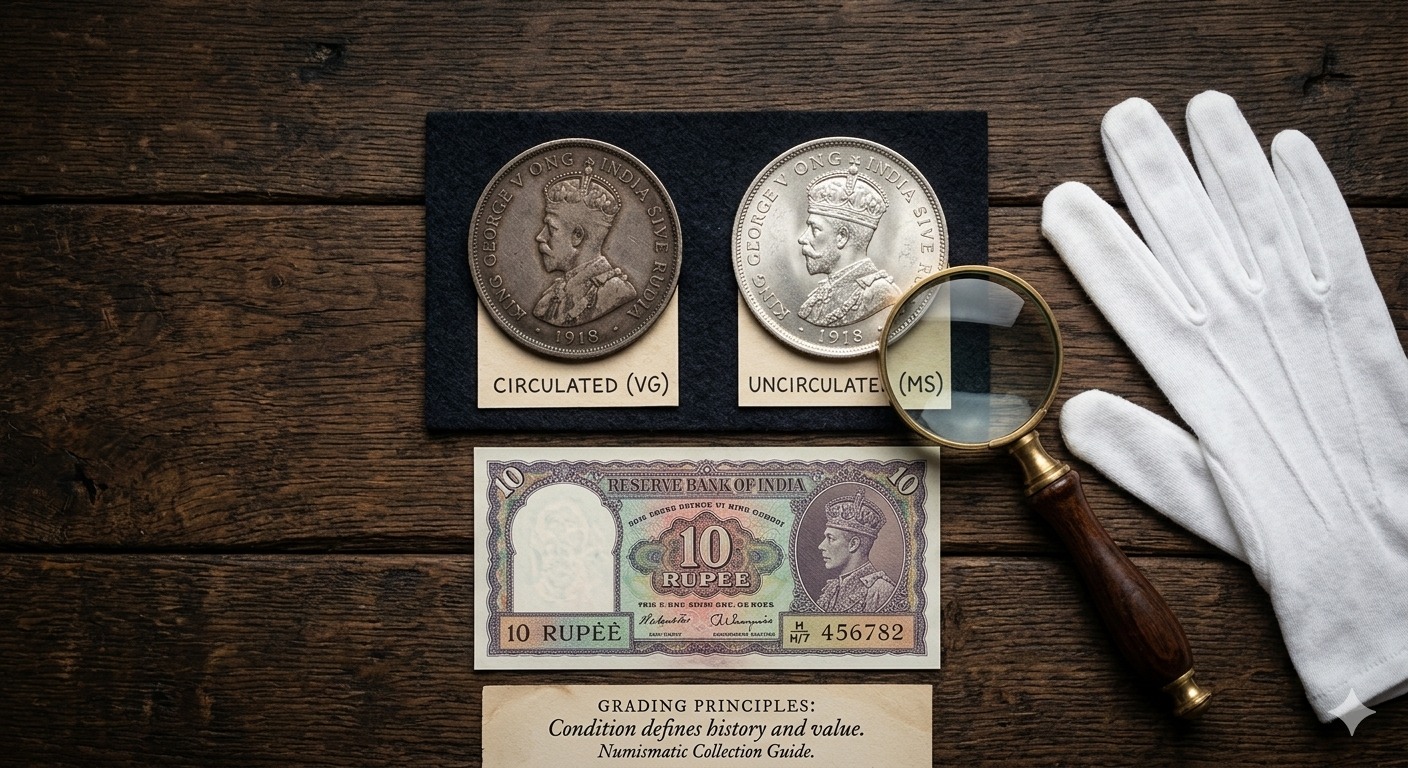

Coin & Banknote Grading FAQs: Understanding Value & Condition
When collecting or investing in rare currency, understanding how condition impacts value is vital. Minor differences in wear can mean a massive difference in market value. Here are the answers to the most common questions collectors ask about currency grading.
Q1: What are the main condition grades for collectible coins?
Coin condition is measured on a standardized scale from heavily circulated to pristine. The primary grades you will see on collector platforms include:
-
- Poor (P) / Fair (FR) / Good (G): Heavily worn coins with visible designs but flattened details, smooth edges, or smooth rims.
- Very Fine (VF) / Extra Fine (XF): Lightly circulated coins. Most design details remain crisp, but minor wear is visible on the highest points of the coin’s surface.
- About Uncirculated (AU): Coins that look completely new at first glance but show very slight traces of friction or wear under a magnifying glass.
- Uncirculated (UNC) / Mint State (MS): Pristine coins that never entered public circulation. They retain their original mint luster, crisp edges, and show absolutely no wear.
Q2: How is paper currency and banknote condition graded?
Banknote grading focuses on paper crispness, crease lines, color brightness, and corner sharpness:
-
- Fine (F): The note shows considerable circulation with multiple folds, creases, or light staining, but the paper isn’t completely limp.
- Very Fine (VF): A crisp note that may have a few vertical and horizontal folds but retains good paper body and cleanliness.
- Choice Uncirculated (CU) / Gem Uncirculated: A note that has never been folded or mishandled. Corners are perfectly sharp, the paper is stiff, and the centering is flawless.
Q3: What are “Fancy Serial Number” notes, and do they affect grading?
Fancy serial numbers do not change the physical grade of the paper, but they add a massive scarcity premium to the note’s market value. Highly collected variations include:
-
- Solid Numbers: Notes where every digit is identical (e.g.,
444444). - Auspicious Numbers: In India, notes ending in
786are highly sought after for cultural and spiritual reasons. - Radar/Palindrome Numbers: Serial numbers that read the same backward and forward (e.g.,
123321).
- Solid Numbers: Notes where every digit is identical (e.g.,
Q4: Should I clean my old coins to improve their grade?
No, never clean your coins. This is the number one mistake new collectors make. Cleaning coins with harsh chemicals, cloths, or abrasives leaves micro-scratches that strip away the natural “mint luster” or historic patina. Professional numismatists can instantly spot a cleaned coin, and doing so can reduce its market value by 50% or more.
Q5: What is the difference between a “Proof Set” and a “UNC Set”?
- Proof Sets: These are specially struck coins made for collectors using polished dies and blanks. They are struck multiple times to create a mirror-like background field and frosted design details. They are never meant for circulation.
- UNC (Uncirculated) Sets: These are struck using standard production dies but are intercepted before entering circulation. They lack the mirror finish of a proof coin but are entirely free of the wear and tear found on pocket change.
